

How to Calculate Fuel Surcharge: A Complete Step-by-Step Guide for Truckers and Shippers
Master how to calculate fuel surcharge using per-mile and percentage formulas. Learn EIA diesel price benchmarks, calculation steps, and fuel purchasing tactics.
When diesel prices spike, fuel can quickly swallow 20% to 30% of a commercial carrier's operating expenses. For independent owner-operators, freight brokers, and shippers alike, understanding how to calculate fuel surcharge is essential to keeping balance sheets healthy and commercial agreements fair. Without a structured formula, volatile diesel swings force carriers to absorb crippling losses or constantly renegotiate base freight contracts.
This comprehensive guide demonstrates how to calculate fuel surcharge across both full truckload (TL) and less-than-truckload (LTL) scenarios. By following these practical steps, anyone learning how to calculate fuel surcharge can produce transparent, verifiable rate adjustments every single billing cycle.
Quick Summary: Fuel Surcharge Formulas at a Glance
A fuel surcharge (FSC) is a financial mechanism designed to offset unexpected diesel price swings above an agreed contract baseline. If you need to know how to calculate fuel surcharge quickly, the freight industry primarily relies on two standard methodologies: the Per-Mile Method (common in Truckload freight) and the Percentage-Based Method (standard in LTL freight).
Understanding how to calculate fuel surcharge begins with the core mathematical definitions:
-
Per-Mile Formula (Truckload / TL):
\text{Fuel Surcharge Per Mile} = \frac{\text{Current Diesel Price} - \text{Base Fuel Peg}}{\text{Fleet Average MPG}}\text{Total Surcharge} = \text{Fuel Surcharge Per Mile} \times \text{Total Billed Miles} -
Percentage Formula (Less-Than-Truckload / LTL):
\text{Total Surcharge} = \text{Base Linehaul Rate} \times \text{Surcharge Percentage}
When logistics professionals teach team members how to calculate fuel surcharge, they typically rely on standardized index matrices to streamline weekly billing.
Quick Reference: Fuel Surcharge Rates Across Diesel Price Tiers
The benchmark schedule below illustrates how to calculate fuel surcharge amounts across different retail diesel market conditions.
| Current Diesel Price (per Gallon) | Base Fuel Peg | Assumed Average MPG | Surcharge per Mile (TL) | Typical LTL Surcharge Rate | Surcharge on a 500-Mile Haul |
|---|---|---|---|---|---|
| $3.25 | $1.25 | 6.0 MPG | $0.333 | 16.5% | $166.50 |
| $3.50 | $1.25 | 6.0 MPG | $0.375 | 18.5% | $187.50 |
| $3.75 | $1.25 | 6.0 MPG | $0.417 | 20.5% | $208.50 |
| $4.00 | $1.25 | 6.0 MPG | $0.458 | 22.5% | $229.00 |
| $4.25 | $1.25 | 6.0 MPG | $0.500 | 24.5% | $250.00 |
| $4.50 | $1.25 | 6.0 MPG | $0.542 | 26.5% | $271.00 |
Note: The figures above illustrate a standard carrier contract assuming a baseline peg of $1.25 and an agreed fuel efficiency of 6.0 miles per gallon. When determining how to calculate fuel surcharge for your operations, always substitute your specific contract variables.
Step-by-Step Guide: How to Calculate Fuel Surcharge (Per-Mile Method)
For truckload carriers, mastering how to calculate fuel surcharge on a cents-per-mile basis ensures that distance-based operating expenses are covered fairly. Follow this 5-step process:
Step 1: Retrieve the Current Fuel Price Index
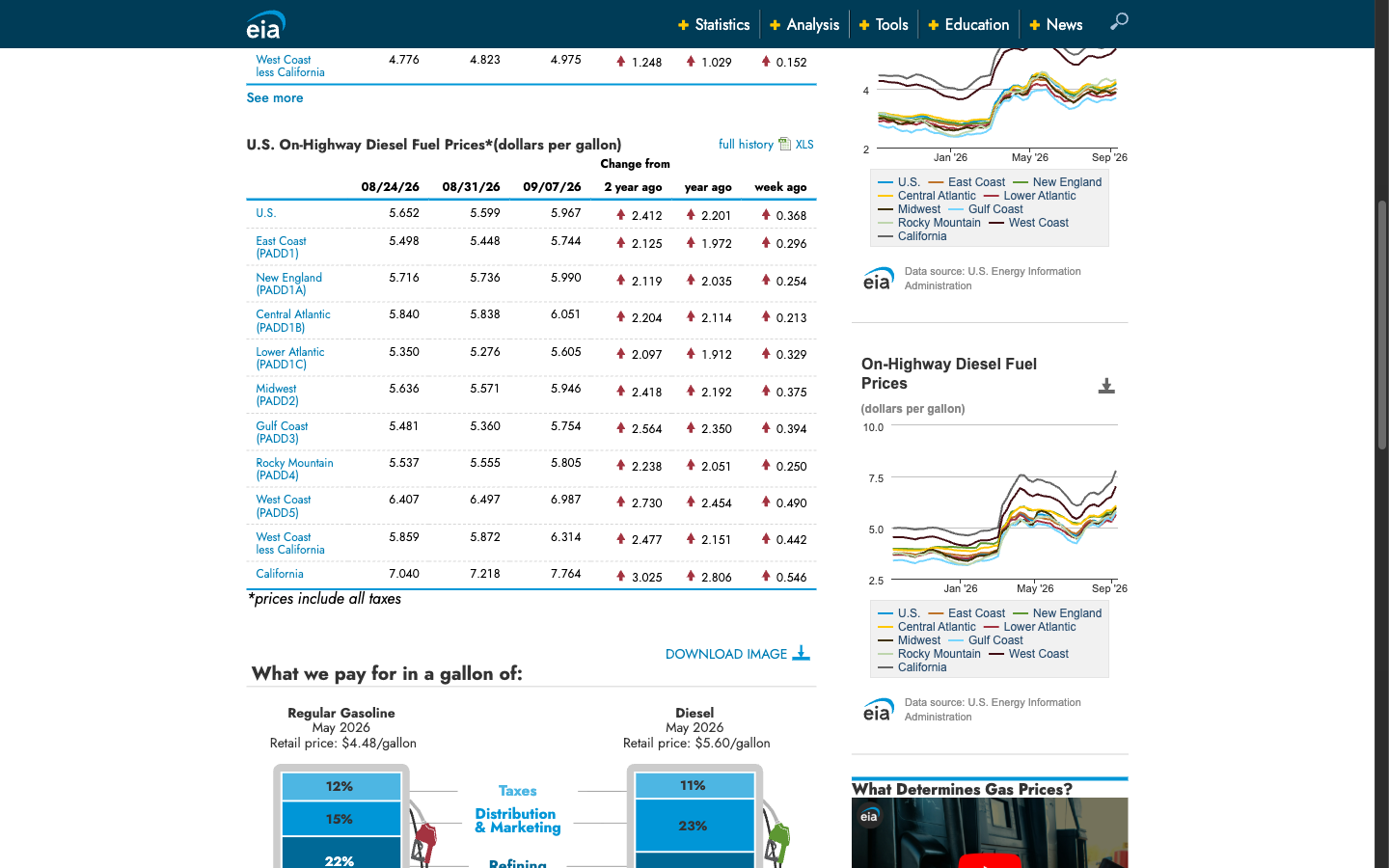
A critical rule in how to calculate fuel surcharge is to avoid using single truck stop receipts. Instead, the freight industry references the weekly on-highway diesel prices published by the U.S. Energy Information Administration (EIA). Released every Tuesday morning at approximately 10:00 AM Eastern Time (pushed to Wednesday on federal holidays), this index provides objective national and regional PADD benchmarks.
Step 2: Establish Your Contract Base Fuel Price (Peg)
To understand how to calculate fuel surcharge accurately, you must know your baseline price. The base fuel peg represents the diesel cost already built into your base linehaul rate. Historically, standard freight contracts set this baseline between 1.20 and 1.25 per gallon. If diesel remains below this figure, no surcharge is triggered.
Step 3: Determine Your Agreed Fuel Efficiency (Average MPG)
Another crucial parameter when studying how to calculate fuel surcharge is vehicle fuel economy. While modern semi-trucks achieve varying efficiency, industry contracts standardly negotiate an assumed fleet average between 6.0 and 6.5 MPG. This benchmark standardizes billing across different tractor models.
Step 4: Calculate the Surcharge Per Mile
At this stage of how to calculate fuel surcharge, subtract the base fuel peg from the current EIA average and divide the result by the agreed MPG rating.
\text{Surcharge Per Mile} = \frac{\text{Current Diesel Price} - \text{Base Fuel Peg}}{\text{Agreed MPG}}
Walkthrough Example:
- Let us assume the current EIA diesel index is $3.85 per gallon.
- Suppose your contract specifies a base fuel peg of $1.25 per gallon.
- Assume an agreed fleet efficiency of 6.0 MPG.
Calculation:
- Fuel Price Spread:
\3.85 - $1.25 = $2.60$ per gallon. - Per-Mile Surcharge:
\2.60 \div 6.0 = $0.4333per mile (rounded to **0.433**).
In this scenario, knowing how to calculate fuel surcharge per mile establishes a rate of $0.433 per billable mile.
Step 5: Multiply by Total Trip Distance
The final step in how to calculate fuel surcharge is multiplying the per-mile surcharge by authorized billable miles.
\text{Total Fuel Surcharge} = \text{Surcharge Per Mile} \times \text{Billed Miles}
For example, assuming a load travels 750 billable miles:
\text{Total Fuel Surcharge} = \$0.4333 \times 750 = \$324.98
Applying this process clarifies how to calculate fuel surcharge transparently, ensuring that a 1,500 base rate combines with 324.98 to yield an invoice of $1,824.98.
How to Calculate Fuel Surcharge for LTL Shipments (Percentage Method)
In less-than-truckload logistics, trailers transport combined freight from multiple shippers. Because individual mileages overlap, carriers need an alternative approach to how to calculate fuel surcharge.
Understanding the Escalating LTL Surcharge Table
Instead of mileage rates, LTL carriers establish a percentage matrix. When carriers instruct dispatchers on how to calculate fuel surcharge for LTL cargo, they apply a percentage schedule:
- Base diesel price brackets are linked to fixed percentage adjustments.
- For every $0.05 increase in the weekly diesel index, the surcharge increases by a set increment (often 0.5%).
Practical LTL Surcharge Calculation
Suppose an LTL shipper books freight with a negotiated linehaul charge of $650.00.
- The current weekly EIA diesel average is $3.80.
- The carrier's published tariff assigns a 21.5% surcharge for this price tier.
Calculation:
\text{Total Surcharge} = \$650.00 \times 0.215 = \$139.75
The total freight charge equals \650.00 + $139.75 = $789.75$. Understanding how to calculate fuel surcharge under percentage rules allows shippers and 3PLs to audit freight bills quickly.
Proven Tips and Warnings for Accurate Surcharge Billing
When refining your routine for how to calculate fuel surcharge, keep these operational best practices and warnings in mind:
Practical Implementation Tips
- Automate Weekly Index Ingestion: To execute how to calculate fuel surcharge without administrative lag, update your TMS every Tuesday following the EIA's 10:00 AM release.
- Standardize Mileage Software: Clarify in contract language whether billable miles derive from PC*Miler, Rand McNally, or Google Maps.
- Align Regional PADD Indices: When operating primarily in high-cost regions, negotiate regional PADD indices rather than national averages.
Costly Warnings to Avoid
- Uncompensated Deadhead Miles: Shippers calculate surcharges strictly on loaded billable miles. If you deadhead 100 miles to a distribution facility, unbilled fuel comes directly from your pocket.
- Absence of Regulatory Mandates: As noted by the Owner-Operator Independent Drivers Association (OOIDA), no federal regulation legally mandates fuel surcharges. You must explicitly secure signed terms in your rate confirmation sheets.
- Distorted Baseline Pegs: When brokers alter the baseline peg without adjusting base rates, knowing how to calculate fuel surcharge helps you detect unviable freight offers.

IFTA Fuel Purchasing Strategy: Maximizing Net Fuel Surcharge Margins
Learning how to calculate fuel surcharge is only half of effective fuel cost management. The other half is mastering an IFTA fuel purchasing strategy.
Under the International Fuel Tax Agreement (IFTA), interstate carriers report miles driven and fuel purchased quarterly across jurisdictions. Because IFTA tax liabilities depend on where you operate rather than where you pump diesel, an uncoordinated fuel strategy can erode your surcharge gains.
1. Separate Pump Prices from Base Fuel Costs
Retail pump prices include state excise taxes, which range from under 0.25 to over 0.78 per gallon. Because IFTA reconciles and credits taxes paid at the pump, choosing fuel stops purely based on pump stickers can be deceptive. When paired with how to calculate fuel surcharge, calculating true base fuel costs (pump price minus local tax) prevents costly tax deficits.
2. Capitalize on Fuel Card Discount Networks
Major fleet fuel card discount networks offer price reductions between 0.30 and 0.60 per gallon at selected travel centers. Because client fuel surcharges are pegged to general EIA retail averages, buying deeply discounted diesel enables you to widen net operating margins on every dispatched load.
3. Balance Purchases to Mitigate Quarter-End Tax Liabilities
Drivers often make the mistake of buying fuel solely in low-cost states while clocking heavy mileage in high-tax jurisdictions. At quarter-end, this creates severe IFTA tax liabilities. By pairing how to calculate fuel surcharge routines with balanced lane purchasing, you protect your cash reserves.
Essential Tools to Protect Your Operating Margins
Applying how to calculate fuel surcharge is vital, but sustainable profitability requires analyzing total lane costs:
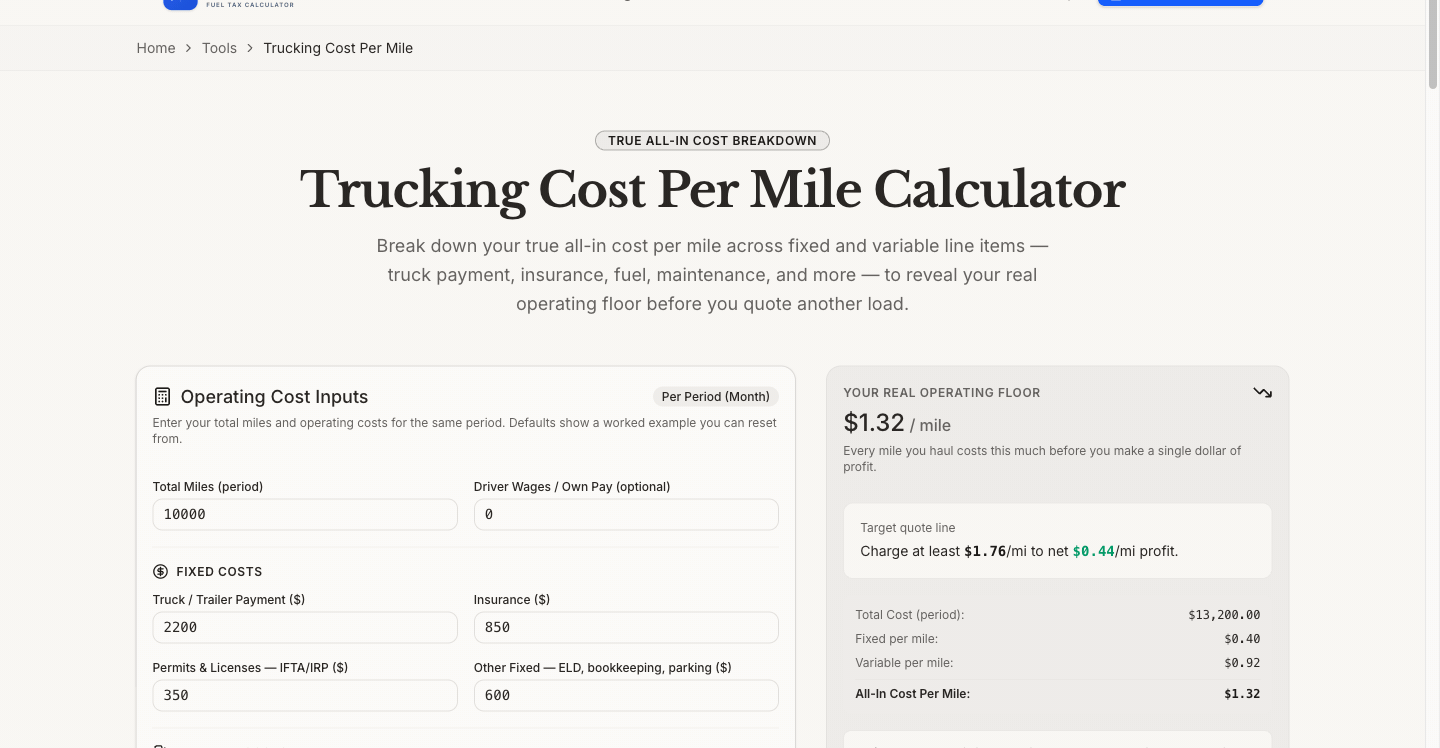
- Evaluate your complete variable and fixed expenses with our trucking cost per mile calculator to understand how diesel shifts affect your bottom line.
- Establish profitable quotes using our rate per mile calculator before confirming your next dispatch.
Note: IFTADesk is our product, engineered by freight industry specialists to give truckers and fleet managers reliable operational calculators and seamless IFTA compliance workflows.
Frequently Asked Questions (FAQ)
Is fuel surcharge legally required in trucking?
No. There is no federal statute requiring shippers to pay fuel surcharges. As explained in official resources by the U.S. Energy Information Administration and industry guides from Mihlfeld & Associates, surcharges are private contractual terms that must be explicitly specified in signed agreements.
Why do carriers use the EIA index instead of local pump receipts?
Local fuel receipts vary unpredictably by brand and exit ramp. Referencing the weekly EIA index provides an impartial, federally verified standard that simplifies how to calculate fuel surcharge for both shippers and carriers, as documented in logistics research by Worldwide Express.
What is the primary difference between per-mile and percentage methods?
The per-mile method establishes a direct cents-per-mile rate based on mileage and fuel efficiency (predominantly in truckload freight). In contrast, the percentage method scales surcharges relative to the base freight rate (standard in LTL), a distinction detailed in fleet guides by Dashdoc. Understanding both methods is fundamental to how to calculate fuel surcharge effectively across different shipping modes.
How often should a fuel surcharge be updated?
Most commercial freight contracts update surcharges once a week, taking effect on the Wednesday following the EIA's Tuesday report. This consistent rhythm ensures that anyone managing how to calculate fuel surcharge stays aligned with wholesale market movements.