

How to Calculate IFTA Fuel Tax in 10 Minutes (Step-by-Step Guide)
Learn how to calculate IFTA fuel tax step by step. Master the 4-step formula, average fleet MPG, jurisdictional fuel consumption, and an end-to-end 3-state calculation example.
Quick Answer: How to Calculate IFTA Fuel Tax
Calculating your quarterly International Fuel Tax Agreement (IFTA) liability boils down to a standardized four-step formula used across all 58 member jurisdictions (48 contiguous U.S. states and 10 Canadian provinces). The fundamental goal of IFTA is to ensure that each state receives motor fuel tax revenue based strictly on the miles your commercial vehicle traveled within its borders, rather than where you purchased fuel.
Here is the four-step calculation workflow at a glance:
- Calculate Overall Fleet Fuel Mileage (MPG): Total Miles Driven Across All Jurisdictions / Total Gallons Purchased = Average Fleet MPG.
- Determine Fuel Consumed in Each Jurisdiction: Specific Jurisdiction Miles / Fleet Average MPG = Gallons Consumed in that State.
- Calculate Gross Fuel Tax Owed Per Jurisdiction: Gallons Consumed * State Fuel Tax Rate = Gross Tax Liability.
- Determine Net Tax Due or Credit: Gross Tax Liability - Fuel Tax Already Paid at the Pump = Net Tax Due or Credit.
If you purchased more fuel in a state than you consumed, you receive a tax credit. If you burned more fuel in a state than you purchased there, you owe tax.

Below, we break down each calculation step in detail, followed by a concrete real-world walkthrough across Texas, Oklahoma, and Arkansas.
The 4-Step IFTA Calculation Formula Explained
Understanding the mathematical mechanics behind the return protects your motor carrier operations from calculation errors, audit adjustments, and penalty assessments.
Step 1: Calculate Overall Fleet Average MPG
Before determining state-by-state fuel liabilities, you must establish the operational fuel efficiency of your vehicle or fleet. Under IFTA compliance rules, you cannot guess or use manufacturer window-sticker ratings; you must use actual quarterly records.
- Formula:
Total Quarterly Miles / Total Quarterly Fuel Gallons = Overall Fleet MPG - Round your MPG to two decimal places (e.g., 6.00 MPG).
- Both loaded miles and empty (deadhead) miles must be included in your total distance figure.
Step 2: Determine Taxable Fuel Consumed per Jurisdiction
Next, divide the distance driven in each specific state or province by your fleet average MPG to determine how much fuel was burned on that state's highways.
- Formula:
Jurisdiction Miles / Fleet Average MPG = Fuel Consumed (Gallons) - This figure represents your statutory fuel consumption for that jurisdiction, regardless of whether you stopped at a truck stop in that state.
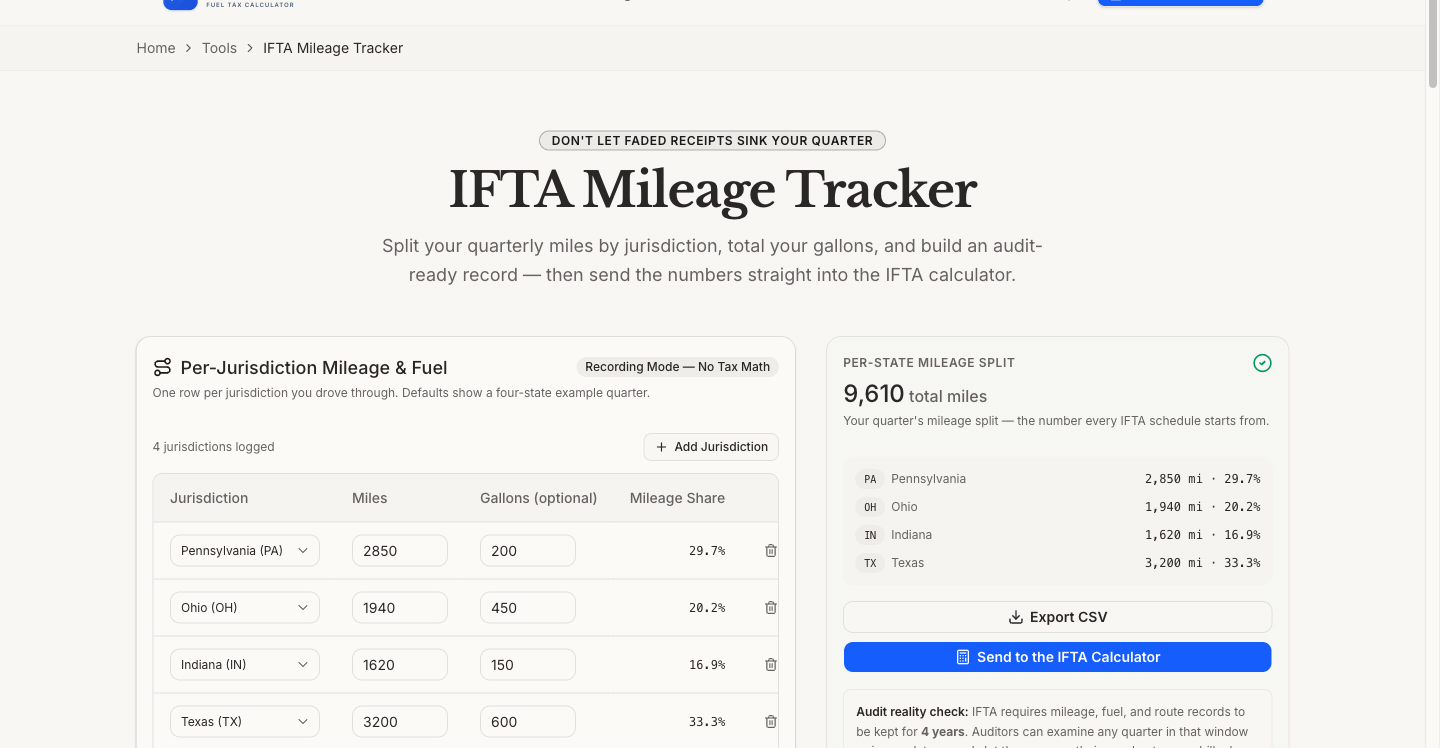
Step 3: Calculate Gross Tax Liability per Jurisdiction
Multiply the fuel consumed in each member jurisdiction by that state's applicable quarterly fuel tax rate.
- Formula:
Fuel Consumed in Jurisdiction * Applicable State Fuel Tax Rate = Gross Tax Liability - Fuel tax rates fluctuate quarterly. Always verify current rates against official state tables or the IFTA Inc. quarterly matrix.
Step 4: Reconcile Tax Paid at the Pump to Calculate Net Balance
When you purchase fuel at a commercial truck stop or retail filling station, state fuel taxes are included in the pump price. You receive credit for the tax already paid on every gallon substantiated by a valid, itemized receipt.
- Formula:
Gross Tax Liability - Tax Paid at Pump = Net Tax Due (or Credit) - If the result is a positive number, you owe that amount.
- If the result is a negative number, you have an overpayment credit that offsets tax due in other states on the same return.
Full Real-World Example: 1 Truck Running Texas, Oklahoma, and Arkansas
To demonstrate how the four-step calculation works in practice, let us examine an end-to-end quarterly filing scenario for a single commercial motor vehicle operating interstate freight routes through Texas, Oklahoma, and Arkansas.
Note on Figures: All trip mileage and fuel purchase volumes below represent example figures for a typical long-haul quarter. Official quarterly diesel fuel tax rates are verified from the IFTA Inc. Tax Matrix (Data verified 2026-09-03, 3Q2026).
Verified 3Q2026 State Diesel Tax Rates (Source: IFTA Inc. Tax Matrix, Data verified 2026-09-03)
- Texas (TX): $0.20 per gallon (diesel: 0.2)
- Oklahoma (OK): $0.19 per gallon (diesel: 0.19)
- Arkansas (AR): $0.285 per gallon (diesel: 0.285)
Scenario Baseline (Example Figures)
- Total Miles Driven: 12,000 miles
- Total Diesel Fuel Purchased: 2,000 gallons
- Fleet Average MPG:
12,000 miles / 2,000 gallons = 6.00 MPG
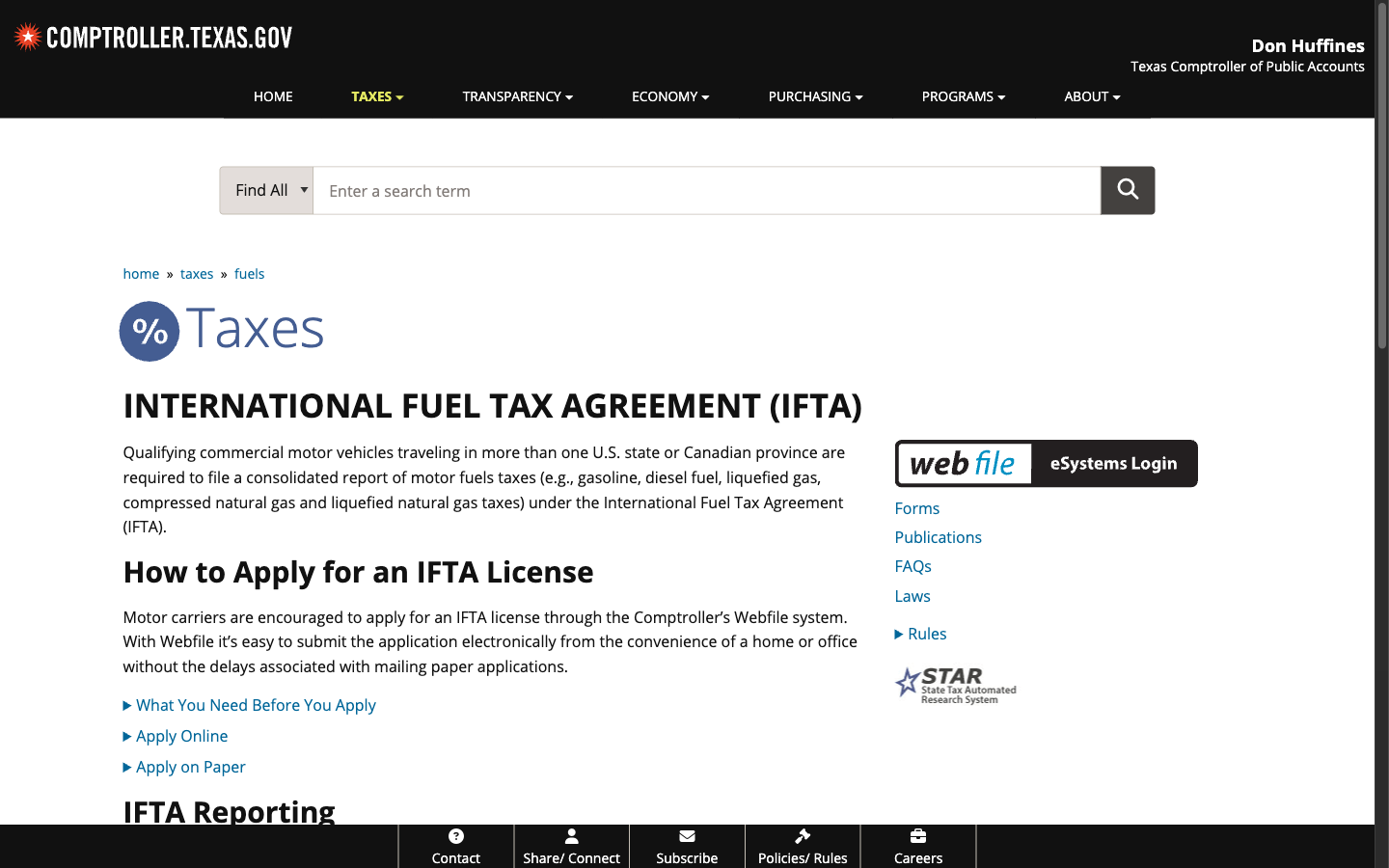
Step-by-Step Breakdown Across the Three Jurisdictions
1. Texas (TX)
- Miles Traveled (example figure): 6,000 miles
- Fuel Consumed:
6,000 miles / 6.00 MPG = 1,000.00 gallons - Gross Tax Owed:
1,000.00 gallons * $0.20 = $200.00 - Fuel Purchased at Pump (example figure): 1,400.00 gallons (driver fueled heavily in Texas due to favorable wholesale prices)
- Tax Paid at Pump:
1,400.00 gallons * $0.20 = $280.00 - Net Texas Balance:
$200.00 owed - $280.00 paid = -$80.00($80.00 Tax Credit)
2. Oklahoma (OK)
- Miles Traveled (example figure): 3,600 miles
- Fuel Consumed:
3,600 miles / 6.00 MPG = 600.00 gallons - Gross Tax Owed:
600.00 gallons * $0.19 = $114.00 - Fuel Purchased at Pump (example figure): 400.00 gallons
- Tax Paid at Pump:
400.00 gallons * $0.19 = $76.00 - Net Oklahoma Balance:
$114.00 owed - $76.00 paid = +$38.00($38.00 Tax Due)
3. Arkansas (AR)
- Miles Traveled (example figure): 2,400 miles
- Fuel Consumed:
2,400 miles / 6.00 MPG = 400.00 gallons - Gross Tax Owed:
400.00 gallons * $0.285 = $114.00 - Fuel Purchased at Pump (example figure): 200.00 gallons
- Tax Paid at Pump:
200.00 gallons * $0.285 = $57.00 - Net Arkansas Balance:
$114.00 owed - $57.00 paid = +$57.00($57.00 Tax Due)
Complete Calculation Summary Table
The table below consolidates the entire 3-state quarterly filing calculation:
| Jurisdiction | Distance Driven (Example) | Fuel Consumed (Gal) | Fuel Purchased (Example) | 3Q2026 Diesel Tax Rate | Gross Tax Liability | Tax Paid at Pump | Net Balance Due / (Credit) |
|---|---|---|---|---|---|---|---|
| Texas (TX) | 6,000 miles | 1,000.00 gal | 1,400.00 gal | $0.20 / gal | $200.00 | $280.00 | -$80.00 (Credit) |
| Oklahoma (OK) | 3,600 miles | 600.00 gal | 400.00 gal | $0.19 / gal | $114.00 | $76.00 | +$38.00 (Due) |
| Arkansas (AR) | 2,400 miles | 400.00 gal | 200.00 gal | $0.285 / gal | $114.00 | $57.00 | +$57.00 (Due) |
| Total / Net | 12,000 miles | 2,000.00 gal | 2,000.00 gal | Multi-State | $428.00 | $413.00 | +$15.00 (Net Due) |
Final Net Settlement
When you submit this return to your base jurisdiction, your Texas credit of -80.00 automatically offsets your liabilities in Oklahoma (+38.00) and Arkansas (+$57.00).
- Net Amount Due:
-$80.00 + $38.00 + $57.00 = +$15.00
Rather than issuing separate checks to three state revenue agencies, you make a single consolidated payment of $15.00 directly to your home state. Your base jurisdiction distributes the funds to Oklahoma and Arkansas while applying your Texas credit.

Statutory Deadlines and Compliance Considerations
Once your calculations are complete, remember that quarterly returns must be submitted on or before official statutory filing deadlines. Under IFTA Articles of Agreement Section R960 (Due Date), returns are due on the last day of the month following each calendar quarter, rolling over to the next business day if the date falls on a weekend or legal holiday.
Maintaining meticulous Individual Vehicle Distance Records (IVDR) and itemized fuel receipts for at least 4 years protects your fleet against audit penalties and default rate assessments.
Calculate Your Quarterly Fuel Tax in Minutes with IFTADesk
Manual calculations across multiple states can lead to transposing numbers, using outdated tax rates, or miscalculating credits.
Skip the manual math and spreadsheet formulas. Use the free IFTADesk IFTA Fuel Tax Calculator to input your trip miles and fuel receipts, apply current 58-jurisdiction tax matrices automatically, and generate audit-defensible quarterly summaries in under 10 minutes without requiring account registration.
Frequently Asked Questions (FAQ)
Can I calculate IFTA fuel taxes manually?
Yes, carriers can calculate IFTA fuel taxes manually using the four-step formula: calculate average fleet MPG, determine fuel consumed per jurisdiction, multiply by the state fuel tax rate, and subtract tax already paid at the pump. However, automated tools help prevent costly math and rate errors.
What happens if I buy fuel in a state with no tax?
All 48 contiguous states and 10 Canadian provinces assess motor fuel taxes. If you fail to retain valid fuel receipts proving that tax was paid at the pump, auditors will disallow your fuel tax credits, requiring you to pay full gross tax liability on all fuel consumed in that state.
How does my base state handle negative IFTA balances?
If your total fuel tax credits exceed your total gross tax liabilities across all jurisdictions, your return produces a net refund. Your base jurisdiction will either issue a refund check or apply the credit balance forward to offset liabilities on your next quarterly return.
What records do I need to support my calculation in an audit?
Under IFTA regulations, carriers must retain detailed trip reports (odometer start/finish, route traveled, jurisdictional mileage splits) and original date-stamped, itemized fuel purchase receipts displaying gallons and fuel type for at least 4 years.
References & Authoritative Sources
- IFTA, Inc. Official Tax Matrix: https://www.iftach.org/ - Official quarterly fuel tax rates for all 58 member jurisdictions (Data verified 2026-09-03).
- IFTA Articles of Agreement (Section R960 - Due Date): Standard filing calendar and statutory due date rollover rules.
- Texas Comptroller of Public Accounts - Motor Fuel Tax: https://comptroller.texas.gov/taxes/fuels/ifta.php - Fuel tax reporting instructions and verified state rates.
- Oklahoma Tax Commission (OTC) - Motor Carrier Division: https://oklahoma.gov/tax.html - Oklahoma quarterly fuel tax compliance standards.
- Arkansas Department of Finance and Administration (DFA): https://www.dfa.arkansas.gov/ - Motor fuel tax reporting guidelines and statutory diesel tax rates.