

What is IFTA? The Complete Interstate Fuel Tax Agreement Guide for Truckers
What is IFTA and how does it work? Learn who needs an IFTA license, how quarterly fuel taxes are calculated across 58 jurisdictions, IFTA vs IRP, and compliance tips.
Quick Answer: What is IFTA and How Does It Work?
If you operate commercial motor vehicles across state borders or international boundaries, knowing what is ifta is essential for maintaining your motor carrier operating authority. The International Fuel Tax Agreement (IFTA) is a cooperative pact among the 48 contiguous United States and 10 Canadian provinces designed to simplify the reporting and payment of motor fuel use taxes by interstate commercial carriers.
Before the agreement took effect across North America in 1996, commercial motor carriers crossing multiple state borders had to purchase individual trip fuel permits at every state port of entry and file separate quarterly tax forms with every jurisdiction they traversed. Under the modernized framework administered by IFTA, Inc., carriers register with a single base jurisdiction—typically their home state or province. Once registered, motor carriers submit just one consolidated fuel tax return every calendar quarter.
Key takeaways every owner-operator and fleet manager should know about what is ifta:
- Single License and Annual Decals: Carriers receive one IFTA license and two annual vehicle decals per qualified truck from their base jurisdiction.
- Fair Fuel Tax Redistribution: The agreement does not eliminate state fuel taxes. Instead, it redistributes fuel taxes fairly to ensure each jurisdiction receives its proper revenue based on the exact miles driven within its territory, regardless of where fuel was purchased.
- Quarterly Reconciliation: Carriers report total miles traveled and total gallons purchased per jurisdiction. The base state reconciles tax credits against tax liabilities, distributing payments or processing refunds on the carrier's behalf.
- Mandatory Participation for Qualified Vehicles: Any commercial vehicle with three or more axles, or with a gross vehicle weight exceeding 26,000 pounds, must comply with what is ifta when conducting interstate operations.

Below is a summary table explaining what is ifta at a glance.
IFTA at a Glance: Understanding What is IFTA and Its Core Rules
To quickly grasp what is ifta and how quarterly compliance works, review the foundational rules established under the official IFTA Articles of Agreement:
| Feature / Requirement | Standard Rule / Baseline | Governing Authority / Source |
|---|---|---|
| Agreement Name | International Fuel Tax Agreement (IFTA) | IFTA, Inc. |
| Member Jurisdictions | 48 contiguous U.S. states + 10 Canadian provinces (58 total) | IFTA Member Jurisdiction Directory |
| Non-Member Jurisdictions | Alaska, Hawaii, Washington D.C., Yukon, Northwest Territories, Nunavut | Statutory exemptions |
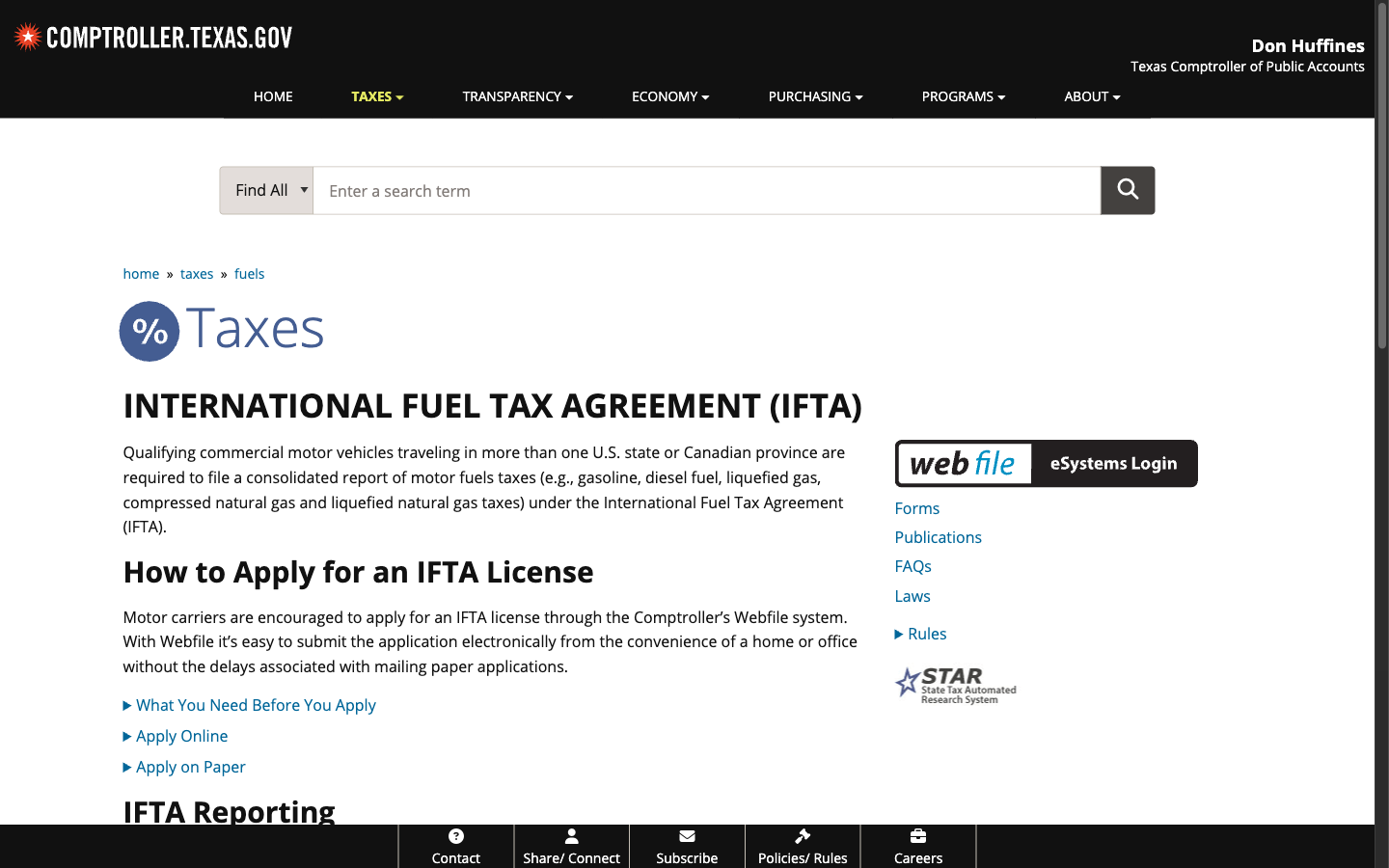
| Qualifying Weight Threshold | Two axles > 26,000 lbs GVW, 3+ axles any weight, or combination > 26,000 lbs | Texas Comptroller |
| Filing Frequency | Quarterly (4 returns per calendar year) | Base Jurisdiction DOR / DOT |
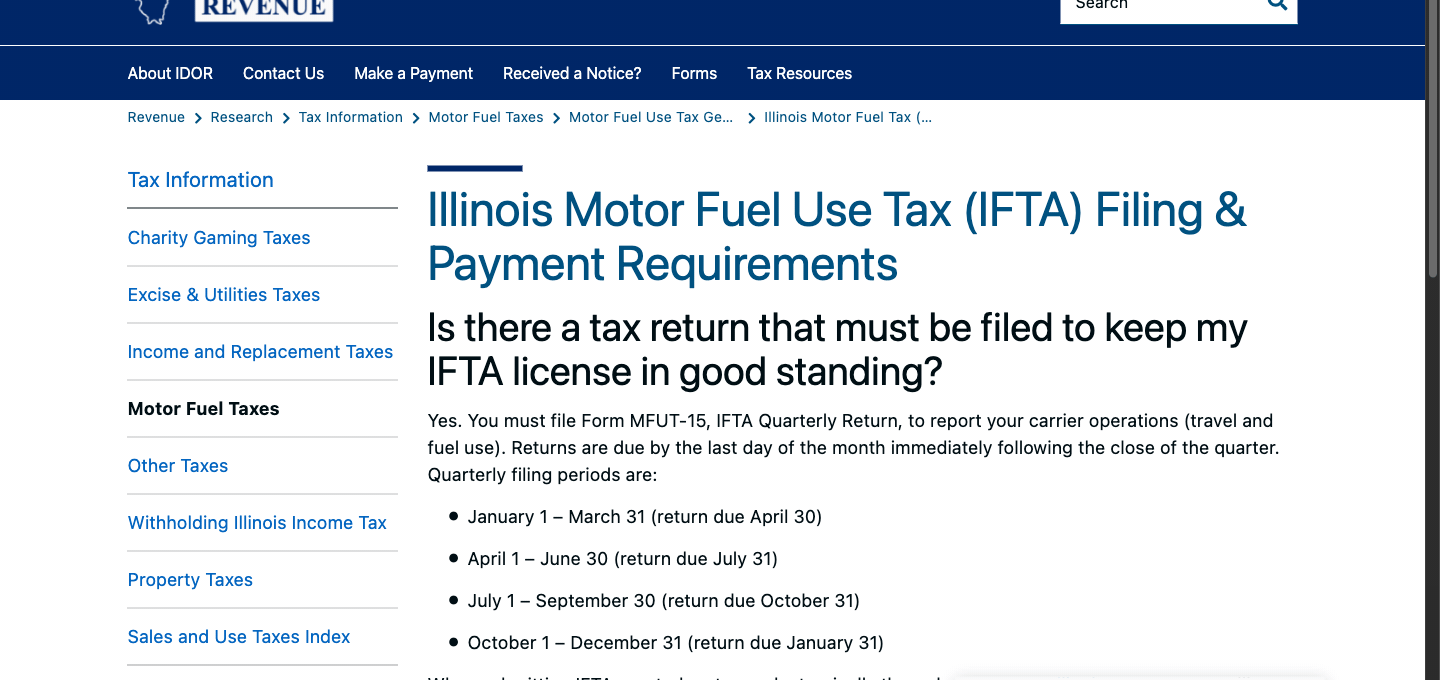
| Quarterly Deadlines | April 30 (Q1), July 31 (Q2), October 31 (Q3), January 31 (Q4) | Colorado Dept of Revenue |
| Late Filing Penalty | Greater of $50 or 10% of delinquent tax liability | IDOR MFUT |
| Statutory Late Interest | interest accrues at the IRS underpayment rate (IRC §6621(a)(2)) plus 2%, adjusted each January 1 for U.S. jurisdictions; Canadian jurisdictions track the bank rate plus 2% (IFTA R1230.100) | IFTA Articles of Agreement Section R1230 |
| Record Retention Mandate | 4 years from return due date or filing date | FHWA USDOT |
Understanding what is ifta also requires knowing which commercial motor vehicles are required to register and file.
Who Needs an IFTA License? Qualified Vehicles Under What is IFTA
When carriers ask what is ifta and who must file, the answer depends on two criteria: whether your vehicle meets the statutory definition of a Qualified Motor Vehicle (QMV), and whether it operates in two or more member jurisdictions.
Qualified Motor Vehicle (QMV) Criteria
Under official regulations enforced by state agencies such as the Texas Comptroller and Colorado Department of Revenue, a vehicle qualifies under what is ifta if it is used, designed, or maintained for the transportation of persons or property and meets any of the following physical criteria:
- Two Axles with Heavy Weight: The motor vehicle has two axles and a registered gross vehicle weight (GVW) or actual gross vehicle weight exceeding 26,000 pounds (11,797 kilograms).
- Three or More Axles: The motor vehicle has three or more axles, regardless of its registered or actual gross weight (such as a tri-axle dump truck or heavy day cab tractor).
- Heavy Combination Vehicles: The vehicle is used in combination (e.g., a tractor-trailer or hotshot setup), and the gross combination weight (GCW) or registered GCW exceeds 26,000 pounds.
If you operate a qualified truck, learning what is ifta ensures you maintain valid operating credentials across all member jurisdictions without risking roadside impoundment.
Exempt Vehicles and Non-Qualifying Operations
When evaluating what is ifta, several transportation categories are explicitly exempt from quarterly fuel tax licensing:
- Strictly Intrastate Operations: Commercial trucks that operate exclusively within their home state boundary do not participate in what is ifta, even if their gross weight exceeds 80,000 pounds. Intrastate carriers pay fuel taxes directly at retail fuel pumps without quarterly reconciliation.
- Recreational Vehicles (RVs): Motorhomes, pickup trucks pulling personal travel campers, and recreational buses used solely for personal pleasure are completely exempt, regardless of weight or axle configuration.
- Government and Municipal Vehicles: Commercial-weight trucks owned and operated by the federal government, state agencies, or local city municipalities are exempt under what is ifta.
- Travel in Non-Member Regions: Operating within Alaska, Hawaii, Washington D.C., or the Canadian northern territories (Yukon, Northwest Territories, Nunavut) does not require an IFTA license because these territories are not member jurisdictions.
How Does IFTA Work? The 4-Step Cycle Explaining What is IFTA
To see what is ifta in real-world trucking operations, you must understand how fuel use tax is calculated. The foundational principle of what is ifta is straightforward: fuel tax is owed to the jurisdiction where the fuel was burned, whereas tax credit is granted by the jurisdiction where the fuel was purchased and taxed at the pump.
Commercial carriers follow a four-step quarterly compliance workflow:
Step 1: Record All Interstate Distance Traveled by Jurisdiction
When implementing what is ifta recordkeeping protocols, every interstate trip requires tracking odometer readings and jurisdictional crossing points. For each qualifying vehicle, motor carriers must record:
- Total miles traveled across all jurisdictions during the calendar quarter.
- Exact taxable and non-taxable miles traveled within each individual state or province.
- Deadhead miles, bobtail transit, and off-duty movements.
Modern motor fleets generally capture this mileage automatically using electronic logging devices (ELDs) or GPS fleet tracking hardware. However, carriers must retain individual vehicle mileage records (IVMRs) to maintain audit compliance.
Step 2: Track Fuel Purchases and Retain Retail Receipts
Whenever fuel is added at a retail truck stop or commercial cardlock station, drivers must obtain and preserve itemized tax-paid fuel receipts. To verify what is ifta tax credits, each receipt must show:
- Date of retail purchase.
- Fuel seller name and complete station address.
- Number of gallons or liters purchased.
- Fuel type (Diesel, Gasoline, CNG, LNG, Propane).
- Vehicle equipment number or truck unit registration.
- Total price paid, demonstrating that fuel excise tax was paid at retail.
Credit card monthly summary statements that omit individual pump receipts and gallon totals are routinely disallowed during state audits.
Step 3: Calculate Fleet Fuel Mileage (MPG) and Net Tax Due
Carriers calculating what is ifta tax liabilities must aggregate all travel logs and fuel receipts at the close of each reporting quarter to determine regional tax balances:
- Calculate Overall Fleet MPG: Divide total miles driven in all jurisdictions by total gallons of fuel purchased.
Overall Fleet MPG = Total Miles Driven / Total Gallons Purchased
For example: Assume a motor carrier logs 24,000 total miles in a quarter and purchases 4,000 gallons of diesel fuel. The overall fleet fuel mileage equals 6.00 MPG (24,000 miles / 4,000 gallons). - Determine Fuel Consumed per Jurisdiction: Divide the miles driven in each specific jurisdiction by your overall fleet MPG.
Jurisdiction Fuel Consumed = Jurisdiction Miles Driven / Overall Fleet MPG
For example: If the truck drove 6,000 miles in Illinois, the fuel consumed in Illinois equals 1,000 gallons (6,000 miles / 6.00 MPG). - Calculate Net Tax Liability or Credit: Multiply the fuel consumed in each state by that jurisdiction's current quarterly tax rate published by IFTA, Inc.. Then subtract the fuel tax already paid at retail pumps within that state.
Net Tax = (Fuel Consumed × State Tax Rate) - (Fuel Purchased in State × State Tax Rate)
If your truck burned more fuel in a state than it purchased there, you owe that state fuel tax. If you purchased more fuel in a state than you consumed there, you generate a tax credit that offsets taxes owed elsewhere.
Step 4: File One Quarterly Return with Your Base Jurisdiction
Instead of filing individual returns with dozens of states, what is ifta allows carriers to submit a single consolidated return directly to their home base jurisdiction. Your base state department of revenue reconciles all state credits and debts:
- Net Payment Due: If your combined liabilities exceed your total credits, you submit a single payment to your base state.
- Net Refund: If your tax credits exceed total liabilities, your base jurisdiction sends you a refund or rolls the credit forward.
- Quarterly Deadlines: IFTA returns are due on the final calendar day of the month following each calendar quarter: April 30 (Q1), July 31 (Q2), October 31 (Q3), and January 31 (Q4). When a due date falls on a weekend or state holiday, the deadline moves to the next business day.
Understanding what is ifta also requires distinguishing it from other interstate trucking registrations.
IFTA vs. IRP: Understanding What is IFTA Compared to IRP
New trucking operators frequently ask what is ifta compared to the International Registration Plan (IRP). While both programs apply to commercial vehicles traveling across state lines, they regulate completely separate aspects of interstate trucking.
| Comparison Parameter | International Fuel Tax Agreement (IFTA) | International Registration Plan (IRP) |
|---|---|---|
| Primary Scope | Motor fuel use tax reporting and redistribution | Commercial vehicle registration and apportioned license plates |
| Governing Authority | IFTA, Inc. | IRP, Inc. |
| Credentials Issued | Paper IFTA license + 2 exterior vehicle decals | Apportioned license plate + Apportioned Cab Card |
| Filing Frequency | Quarterly (4 tax returns per year) | Annual renewal based on base jurisdiction staggered schedules |
| Calculation Basis | Fuel consumed vs. fuel purchased per jurisdiction | Apportioned registration fee based on distance percentages |
| Key Audit Items | Fuel pump receipts, odometer continuity, fleet MPG | Annual state mileage logs, vehicle titles, registration records |
In simple terms, IRP grants your truck the legal registration to operate in multiple states under a single license plate, whereas what is ifta ensures each state receives the motor fuel taxes it is owed for road maintenance.
Common IFTA Mistakes: What is IFTA Compliance Risk?
Failing to adhere to what is ifta regulations can expose motor carriers to expensive audit assessments and credential revocations. Watch out for these four common pitfalls:
1. Incomplete or Illegible Fuel Receipts
For operators studying what is ifta, the leading cause of audit penalties is inadequate fuel recordkeeping. Tax auditors from agencies like the Illinois Department of Revenue will disallow tax-paid fuel credits if receipts fade, lack pump addresses, or omit gallon quantities. Disallowed receipts force carriers to repay the fuel tax a second time, plus interest and penalties.
2. Missing "Zero-Mile" Quarterly Returns
Many owner-operators assume that if their truck was out of service or operated solely within their home state during a quarter, no filing is necessary. This is a severe misunderstanding of what is ifta.
All licensed carriers must submit a quarterly report even when reporting zero miles. Missing the filing deadline on a zero-operation return triggers an automatic statutory $50 late filing penalty under IFTA Articles of Agreement Section R1220.
3. Unaccounted Odometer Gaps and Personal Conveyance
Under what is ifta recordkeeping rules, every mile turned by a qualifying vehicle must be accounted for—including loaded miles, empty deadhead transit, bobtail movements, and off-duty personal conveyance. If state auditors detect unrecorded odometer jumps between trips, they can reject your reported fleet MPG and apply a statutory default penalty rate (often 4.0 MPG), substantially inflating your tax bill.
4. Failing the 4-Year Record Retention Mandate
A fundamental requirement of what is ifta is documentation retention. State tax authorities and the Federal Highway Administration mandate that motor carriers preserve all daily trip sheets, driver logs, GPS records, fuel invoices, and quarterly summary sheets for four years from the return due date or filing date. Discarding documentation early leaves carriers unable to defend their deductions during an audit.
Best Practices: Managing What is IFTA Simply and Accurately
For carriers navigating what is ifta for the first time, managing fuel tax calculations on paper logs or generic spreadsheets takes valuable time away from hauling freight. To ensure clean compliance and protect your business:
- Automate Mileage Data: Use an electronic logging device (ELD) or GPS tracking system to record mileage by state automatically.
- Track Operating Costs Continuously: Monitoring cost per mile helps you anticipate quarterly tax obligations. Carriers can utilize our free trucking cost per mile calculator to assess fuel expenses across routes.
- Digitize Fuel Invoices Immediately: Photograph or scan paper fuel receipts at the truck stop to safeguard against ink fading and lost paperwork.
- Use Dedicated Tax Software: Rather than compiling complex fuel tax matrices by hand, automated platforms eliminate mathematical mistakes.
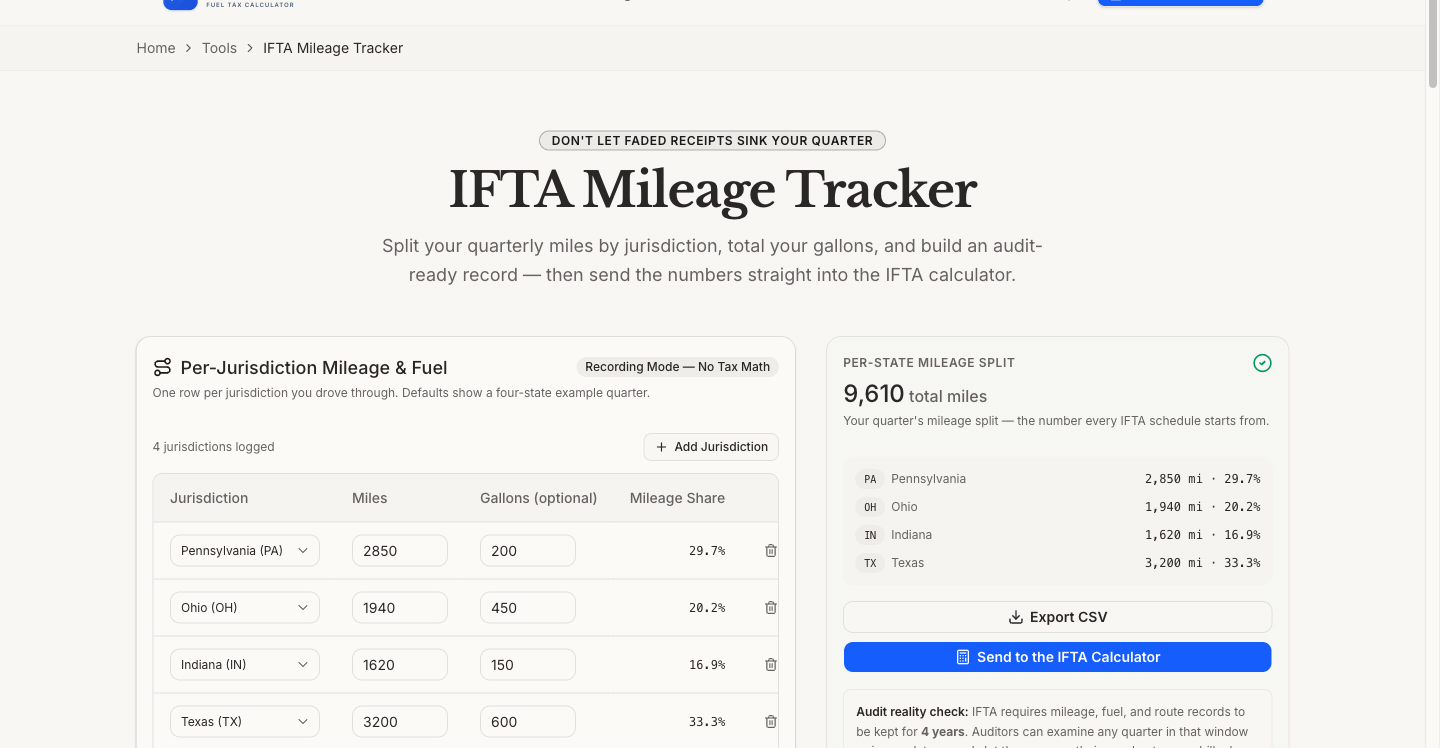
Note: IFTADesk is our product; we've aimed to evaluate all tools objectively. Motor carriers looking to streamline what is ifta reporting can use an automated IFTA mileage tracker to generate accurate, audit-ready quarterly reports in minutes.
Frequently Asked Questions (FAQ)
What does IFTA mean in trucking?
When asking what is ifta, the acronym stands for the International Fuel Tax Agreement. In commercial trucking, it is a cooperative pact among 48 U.S. states and 10 Canadian provinces that allows interstate motor carriers to report and pay fuel taxes to a single base jurisdiction rather than filing with each state individually.
Do local trucks need IFTA?
No, local commercial trucks that operate exclusively within a single home state (intrastate commerce) do not need an IFTA license or decals. Understanding what is ifta means recognizing that IFTA only applies to qualified vehicles crossing state or provincial boundaries.
What is required for IFTA reporting?
When preparing what is ifta quarterly reporting, carriers must provide their carrier identification numbers, total distance traveled across all states, exact miles logged in each individual jurisdiction, total gallons of fuel purchased with valid tax receipts, and calculated average fleet fuel mileage (MPG).
What happens if you don't file IFTA?
For carriers who fail to comply with what is ifta, missed reports result in an immediate penalty of $50 or 10% of the delinquent tax due (whichever is greater), along with interest accruing at the IRS underpayment rate (IRC §6621(a)(2)) plus 2%, adjusted each January 1 for U.S. jurisdictions; Canadian jurisdictions track the bank rate plus 2% (IFTA R1230.100). Continued failure leads to license suspension, decal revocation, roadside vehicle impoundment, and mandatory bond requirements.
What is the difference between IFTA and IRP?
The difference between what is ifta and IRP lies in their regulatory purpose: IRP handles commercial vehicle registration fees and multi-state apportioned license plates, while IFTA governs the reporting and redistribution of motor fuel use taxes based on miles driven in each state.
References & Authoritative Sources
- IFTA, Inc. Official Portal: https://www.iftach.org/ - Official Articles of Agreement, quarterly tax rate matrices, and member jurisdiction directory.
- Texas Comptroller of Public Accounts: https://comptroller.texas.gov/taxes/fuels/ifta.php - Motor fuel use tax regulations, base jurisdiction rules, and late filing consequences.
- Colorado Department of Revenue - Taxation: https://tax.colorado.gov/IFTA - State IFTA filing instructions, quarterly calendar deadlines, and decal display rules.
- Federal Highway Administration (FHWA): https://www.fhwa.dot.gov/ - Federal motor carrier operating framework and interstate commercial vehicle guidelines.
- Internal Revenue Service (IRS): https://www.irs.gov/businesses/small-businesses-self-employed/trucking-tax-center - Federal Heavy Highway Vehicle Use Tax (Form 2290) and commercial trucking tax compliance.
- Illinois Department of Revenue (IDOR): https://tax.illinois.gov/research/taxinformation/motorfuel/mfut/filepay.html - Motor Fuel Use Tax compliance, electronic reporting, and audit requirements.